
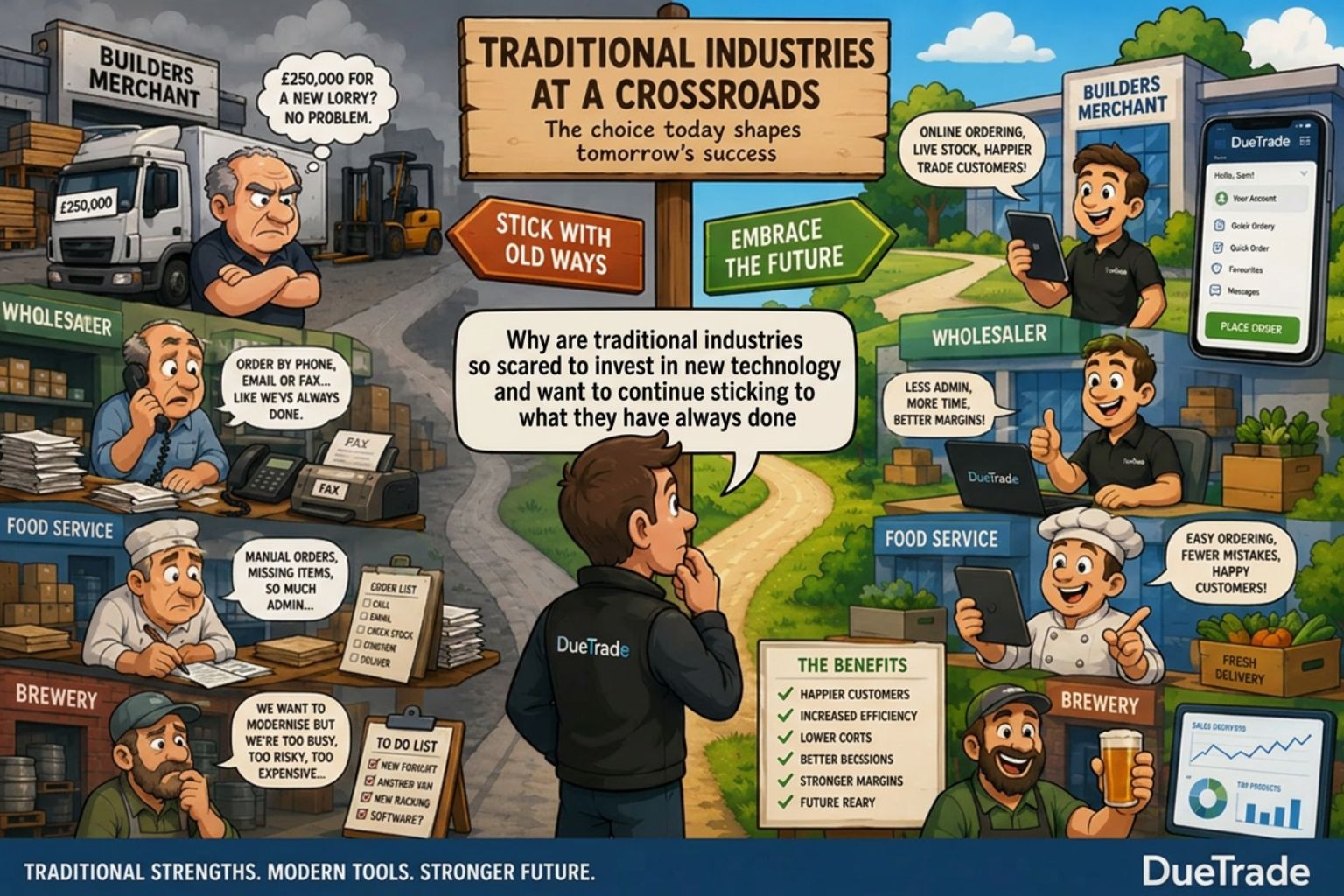
For decades, industries like builders’ merchants, wholesalers, food service suppliers, breweries and trade distributors have been built on relationships, reliability and operational graft. These are businesses that keep the UK moving. They deliver materials to sites at 6am, supply pubs before the weekend rush, and keep restaurants, farms and independent retailers stocked every single day.
But across these sectors, there’s a growing feeling that something is shifting.
Margins are tighter. Labour costs are rising. Customer expectations are changing. And while most business owners agree that digital transformation is important, many are still struggling to commit investment into software and operational technology.
The question is: why?
Speak to enough people across traditional industries and a familiar pattern emerges.
Many businesses understand they need better systems. They know manual ordering, WhatsApp messages, spreadsheets and phone-call-based processes are inefficient. They know their customers increasingly expect digital convenience.
But when it comes to actually investing in software, hesitation kicks in.
Ironically, some businesses will spend £250,000 on a new delivery lorry without blinking, but pause over a £15,000 investment into an ordering platform that could modernise operations for the next decade.
That doesn’t necessarily mean these businesses are anti-technology. In many cases, it’s the opposite. They want to modernise — but uncertainty, rising costs and cultural habits make software feel riskier than physical assets.
And that mindset is more common than many realise.
Recent research into the builders’ merchant sector found that more than a quarter of construction suppliers are struggling to keep pace with digital change, while 21% openly admit they are “falling behind”.
Another industry report highlighted that “cost concerns and resistance to change” remain major barriers to digital investment, with 57% of businesses struggling to align eCommerce and digital strategies with broader business goals.
It’s easy to blame “boomers running businesses” or assume older leadership teams simply do not understand technology.
But the reality is more nuanced.
Many traditional businesses were built in an era where value was tangible:
Software, by comparison, can feel abstract. Difficult to measure. Harder to trust.
A forklift is visible. A new lorry feels productive immediately. A software platform requires behavioural change, training and patience before the return becomes obvious.
That creates a psychological challenge, especially in sectors where businesses have historically survived through caution and operational discipline rather than aggressive innovation.
There is also a wider economic backdrop influencing decision-making.
Across the UK SME market, businesses are increasingly cautious about borrowing and investing due to inflation, labour costs and uncertainty around future growth.
Government research into technology adoption found that affordability, business risk and uncertainty around implementation are among the biggest reasons businesses delay investing in new technology.
So the hesitation is often less about ignorance — and more about fear of getting it wrong.
One of the biggest misconceptions about UK trade industries is that they are already fully digitised.
In reality, many businesses still rely heavily on:
That might work when a company is smaller, but operational cracks start appearing as businesses scale.
A recent construction industry report found that 91% of delivery-related documentation failed to meet basic data quality standards, creating huge inefficiencies across supply chains.
At the same time, digital skills gaps are becoming increasingly visible across industrial sectors. Nearly half of UK manufacturers and wholesalers say lack of digital expertise has already affected growth or projects.
The challenge is no longer whether digital systems matter.
It’s whether businesses can afford to stay fragmented while competitors modernise.
Trade buyers are changing.
The next generation of procurement managers, site managers, hospitality operators and business owners grew up with Amazon, Uber and instant digital access. They increasingly expect:
Traditional industries are slowly being pulled toward modern customer expectations whether they like it or not.
And interestingly, many sectors already recognise this shift.
Research from the builders’ merchant sector shows nearly half of firms now see AI and automation as the biggest driver shaping future growth strategies.
The appetite is there.
The execution is where many businesses struggle.
Technology itself is rarely the main problem anymore.
Adoption is.
Even online industry discussions show the same recurring themes:
One construction technology discussion summed it up bluntly: “New con-tech isn’t the problem — getting it adopted is.”
That reflects a wider truth across traditional industries.
Software only works if businesses commit to operational change alongside the technology itself.
Despite all the hesitation, there’s a strong argument that traditional industries are entering one of their biggest opportunities in decades.
Because many sectors are still early in their digital journey.
Unlike large corporates weighed down by massive legacy systems, SMEs and mid-sized trade businesses can often move faster once they commit.
Businesses that modernise now could gain advantages through:
And importantly, digital transformation is no longer just about “having an app”.
It’s becoming operational infrastructure.
The businesses that digitise successfully over the next five years may eventually look as different from today’s competitors as online banking looked compared to traditional banking twenty years ago.
Traditional industries are not broken.
In many ways, they are some of the most resilient sectors in the economy.
But resilience alone is becoming less enough.
The next generation of successful wholesalers, merchants, breweries and food service companies will likely be the businesses that combine:
with:
The encouraging part is that most business owners already know this.
The hesitation we’re seeing across the market is not a lack of awareness. It’s uncertainty around timing, investment and confidence.
But history usually rewards industries that adapt before they are forced to.
And for traditional trade sectors, that transition now feels less like a future trend — and more like the next stage of survival and growth.
Get in touch: sales@duetrade.co.uk
Socials: @DueTrade

Get in touch
The best way to see what your app could look like is to set up a call today.


.jpg)
