November 12, 2026
Stop Confusing AI Prompts With Software Engineering.
There's a growing attitude in the business world that professional software developers are no longer needed because AI can build software.
"I've built my own app using AI. Why would I pay a developer?"
It's an interesting argument, but I think it fundamentally misunderstands what software development actually involves.
Don't get me wrong. We're huge advocates of AI at DueTrade. We use it extensively throughout our development process, and it makes our team considerably more productive. We also love the fact that it's giving more of an open landscape to everyone and anyone to understand more about software development and to be as creative as they like.
We can all agree that change is good, new ideas are great, new businesses being started because of AI are fantastic for economic growth and as Barack Obama – Former US President
"The key to our success will be to compete by developing new products, by generating new industries, by maintaining our role as the world's engine of scientific discovery and technological innovation."
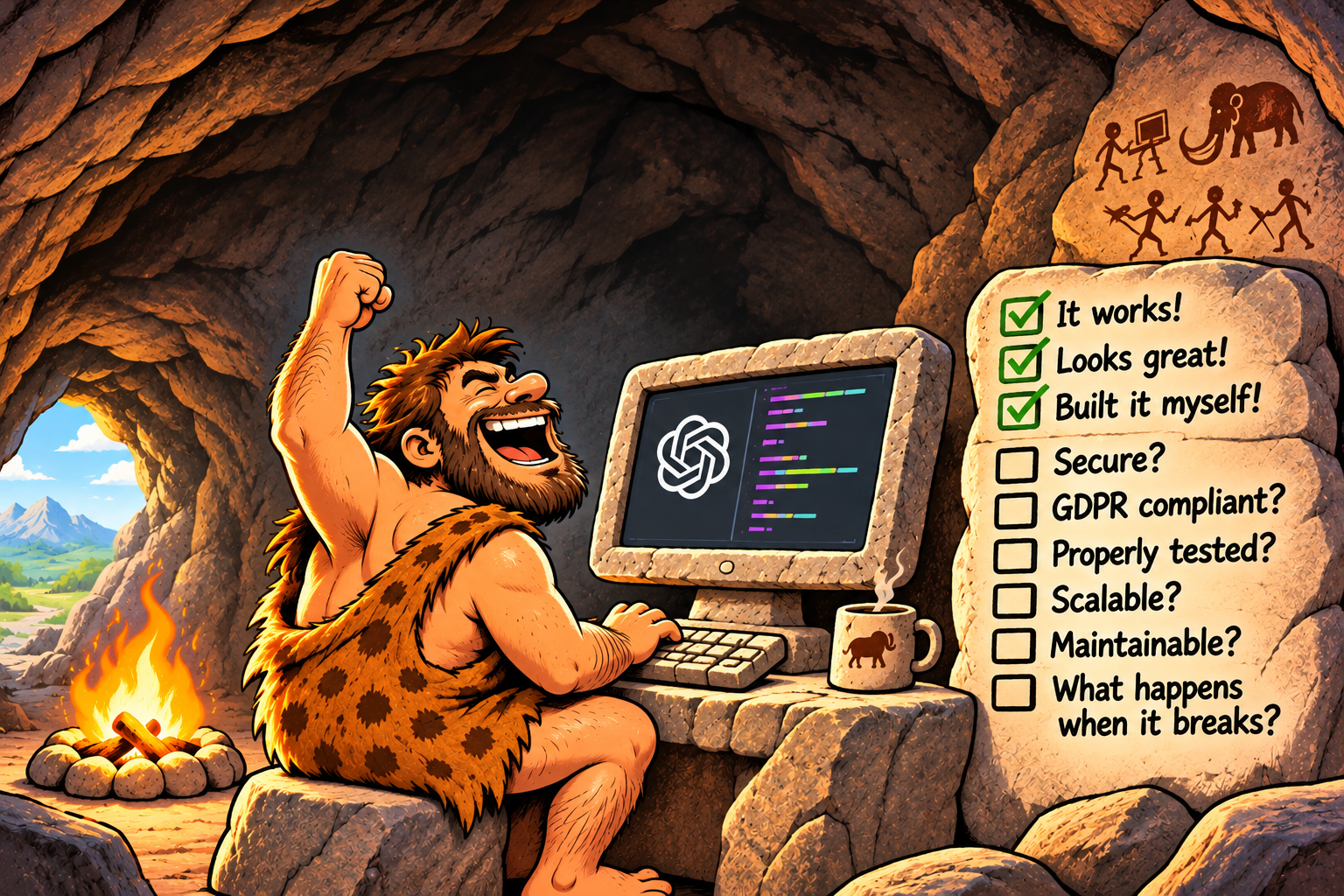
But there's a massive difference between getting AI to generate an application and having the technical expertise to know whether what it's built is actually any good.
AI can create interfaces, generate code, connect databases and build functionality. It can potentially get you 80% of the way there.
But can you independently verify that:
And perhaps most importantly, do you understand what to do when something goes wrong?
The biggest danger isn't necessarily that AI builds something that doesn't work. It's that you don't have the technical knowledge to recognise what might be wrong with it.
A working prototype isn't the same as professional, business-critical software. Yes, you can test it but you never reeaally know the bugs (what's wrong with it) until it's out with its intended users.
At DueTrade, we embrace AI. We use it to accelerate development, improve efficiency and help our developers build better products.
But we still need professional developers who understand software architecture, security, infrastructure, databases, testing and everything else that goes into delivering a reliable product. AI can get you 80% of the way there, which is fantastic. That final 20% is often where the most important technical work happens. It's not necessarily 20% of the coding. It's the expertise, judgement and responsibility needed to turn something that appears to work into something a business can safely rely on.
Here's what a professional developer brings to that final stage.
1. Code review - Reviews AI-generated code, identifies mistakes, removes unnecessary code and improves its quality.
2. Architecture - Ensures the application is structured correctly so it can be developed, maintained and expanded.
3. Security - Identifies vulnerabilities, secures authentication, permissions, APIs and protects sensitive information.
4. GDPR and compliance - Ensures appropriate data protection measures, access controls, retention and deletion processes are implemented.
5. Database integrity - Ensures information is stored correctly, relationships are sound and data cannot easily become corrupted or duplicated.
6. Testing - Carries out functional, integration, regression, performance and security testing, including scenarios AI may have overlooked.
7. Scalability - Makes sure the application can cope with increasing users, transactions and data volumes.
8. Integrations - Ensures connections to accounting software, payment providers, stock systems and third-party APIs work reliably.
9. Infrastructure - Configures hosting, deployment, monitoring, backups and disaster recovery.
10. Performance - Identifies inefficient code, database bottlenecks and unnecessary processing that could slow the application down.
11. Error handling - Makes sure the application responds safely when something fails, rather than losing data or leaving processes incomplete.
12. Maintenance - Establishes a maintainable codebase and manages updates, dependencies, security patches and future development.
AI hasn't removed the need for developers. It's given good developers a much more powerful set of tools.
By all means, experiment, build prototypes and use AI to bring your ideas to life.
But don't confuse being able to generate software with being able to engineer it.
Knowing how to use AI doesn't automatically make you a software developer.
I'd be interested to hear other people's thoughts. Are we underestimating the technical risks of AI-generated software?
Get in touch: sales@duetrade.co.uk
Socials: DueTrade

Get in touch
The best way to see what your app could look like is to set up a call today.