

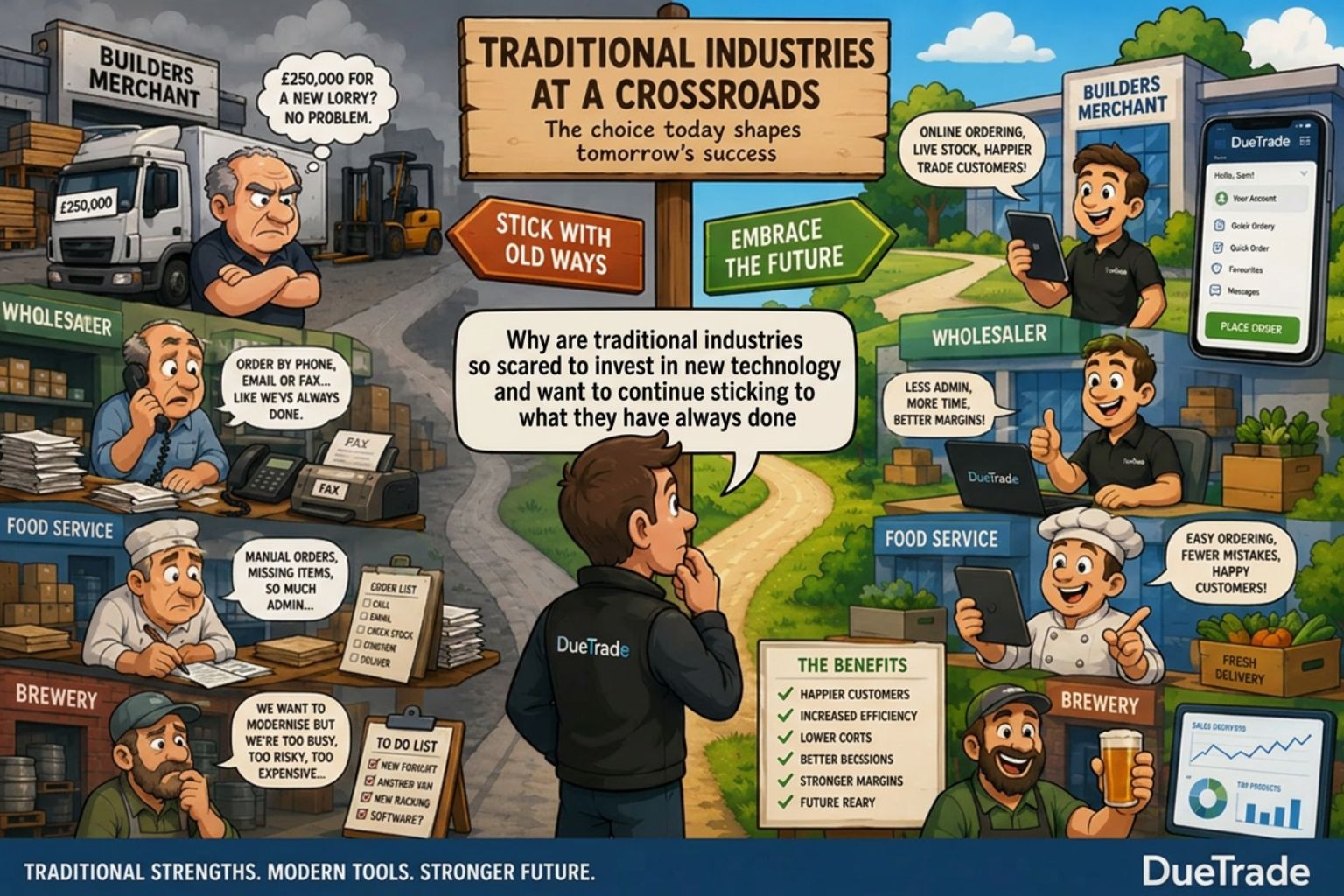
Most suppliers still rely on phone calls, emails, or physical brochures to take trade orders, but few realise how much time and money it’s actually costing them. While these methods may be familiar and reliable, the high operational cost can go unnoticed.
Manual order processing is time-consuming, prone to errors, and increasingly misaligned with how modern B2B buyers expect to place orders. When multiplied across dozens of orders each week, the administrative burden can quietly drain both time and budget.
Compared to manual ordering methods, a B2B ordering app (link to new Service page) eliminates or significantly reduces the time spent on many routine administrative tasks, including:
By automating these tasks, an ordering app allows orders to flow directly from the customer into internal systems with minimal manual intervention, freeing up teams to focus on higher-value work.
We crunched the numbers and calculated that for every order that comes in manually, your team could be spending 15–30 minutes per order chasing details, confirming pricing, and keying data into systems.
Imagine a business handling between 30 and 100 orders per week over the course of a year. Based on these volumes, manual order processing can consume anywhere from 375 to more than 2,500 administrative hours annually. This is time that could otherwise be spent on customer relationships, improving sales, or operational improvements.
In an ecommerce platform, customers place orders directly through a centralised app where pricing, product availability, and customer-specific terms are already configured. The platform automatically captures order data and integrates it with internal systems.
As a result, staff involvement is typically reduced to 0–5 minutes per order, mainly for the occasional handling or oversight.
Over a year, this can reduce total administrative time to approximately 50–250 hours, representing a time saving of 325–2,250 hours annually. For many businesses, this equates to several months of full-time administrative capacity.
As B2B buyers increasingly expect faster, more self-service purchasing experiences, manual ordering methods become a barrier to growth. Trade brochures and manual processes often limit scalability and put unnecessary strain on internal teams.
A modern B2B ecommerce platform doesn’t just reduce administrative effort - it enables suppliers to operate more efficiently, respond to customer needs more quickly, and build a more scalable foundation for future growth.

Get in touch
The best way to see what your app could look like is to set up a call today.


.jpg)
